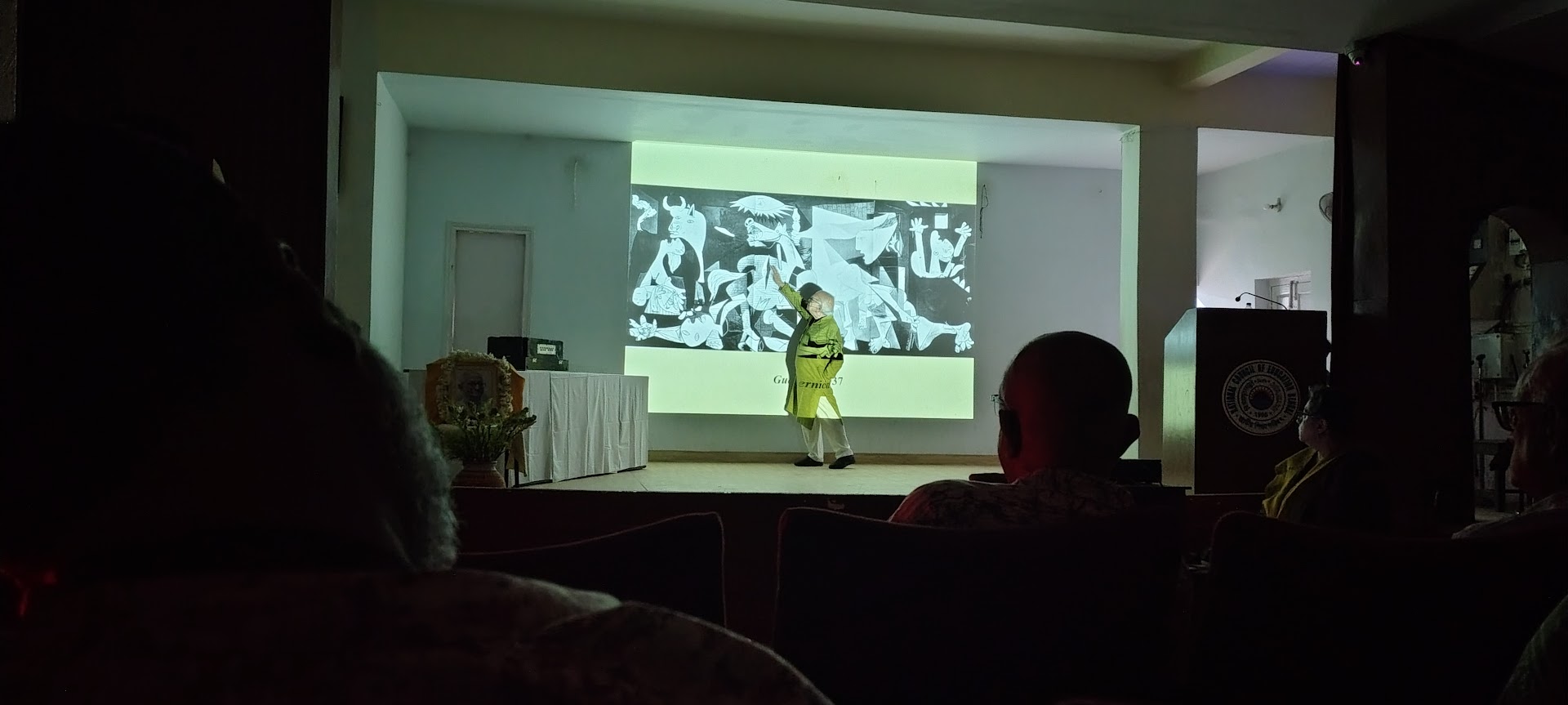
Samik Bandyopadhyay is one of the most significant theatre scholars and critics India has produced — Bengali, Kolkata-based, with decades of work spanning dramatic literature, film criticism, and cultural history. His scholarship on Tagore’s plays carries rare depth; he reads them not as literary texts secondarily staged, but as theatrical architectures with their own internal logic.
That lens matters enormously when the play in question is Raktakarabi (Red Oleander, written 1923–24, published 1926) — Tagore’s most politically charged dramatic work, a symbolic indictment of a mechanized, extractive power structure that devours human life and suppresses beauty, desire, and freedom. Nandini, the central figure, is essentially a force of living protest against this dehumanizing order.
To illuminate this, Bandyopadhyay places Guernica beside it — Picasso’s 1937 response to the Nazi bombing of a Basque civilian town, a visual scream against state violence rendered in expressionistic, non-realistic form. The structural rhyme is precise: both works refuse documentary neutrality, both use fractured form to render what realism cannot — the interior experience of systemic annihilation — and both were made before the full catastrophe they seemed to prophesy had revealed itself completely.
In doing so, Bandyopadhyay is making a scholarly and civilizational claim: that Raktakarabi belongs in the same register of world literature as anything produced in Europe in that era, not as regional Bengali theatre, but as modernist political vision of the first order.